

A few years back, when the AI revolution was really taking off and there were concerns, I wrote a blog post about the topic. I focused heavily on the environmental impact of AI but didn’t dig into many other topics. Because this is such a hot topic, and I admit to having some confusion, I decided to dig in a bit more and do some research. One thing I really wanted to understand was the difference between generative AI and what some call AI tools, because I think this distinction is often used by the writing community when declaring what is acceptable and what is not. Although, granted, some have an aversion to it all and categorically label all AI bad. I am not at all writing this to change anyone’s position on AI; I simply wanted a better understanding. So…I went into the history and tried to differentiate between Generative AI and AI, which coincidentally has existed since 1956.
- At a Dartmouth conference in 1956, the term “artificial intelligence” was coined by John McCarthy. At the time, there was a small group of researchers credited with founding the field. So…let that sink in. AI has been around for decades, not just the computer, but a machine that was capable of “human intelligence”–a thinking machine.
- ELIZA was the first chatbot, created in 1966 by MIT computer scientist Joseph Weizenbaum. ELIZA was a therapy chatbot that took answers users gave and turned them into questions to prompt more conversation.
- There is an actual professional organization called The American Association of Artificial Intelligence, formed in the 1980s.
- The first self-driving car was invented by German scientist Ernst Dickmanns, and it was nothing more than a Mercedes van outfitted with a computer system and sensors.
- The first robot to simulate human emotions was Kismet, a “social robot,” created in MIT’s Artificial Intelligence Laboratory and led by Dr. Cynthia Breazeal. Basically, the machine was programmed to read and mimic human feelings through sensors and microphones.
- SIRI was born in 2011, developed for the iPhone as an AI assistant capable of answering questions. Then, because Amazon just had to get in the game, ALEXA was introduced on November 6, 2014, and broadly rolled out in early 2015.
- So now we get to the generative AI craze starting in 2020 with ChatGPT-3.0. But in reality, it started before that in 2014, when Ian Goodfellow introduced GANs (Generative Adversarial Networks) that pitted two neural networks against one another—a generator trying to create fake images and a discriminator trying to catch them. This really started the craze of creating realistic-looking media. And for writers…the beginning started with Google researchers who published a paper titled “Attention Is All You Need,” introducing the Transformer architecture, which allowed AI to process the context of entire sentences simultaneously rather than word-by-word, which allowed generative writing to explode.
- For cover artists, Generative Fill and Generative Expand were introduced in the September release of Adobe Photoshop. And in March 2023, Canva introduced Magic Write, Magic Design, Text to Image, and Magic Edit and Eraser. It starts getting a little gray when we begin digging into the tools, like the Magic Eraser. Traditionally, using the eraser tool in Adobe and Canva was not generative AI, but the tools are getting so much better, it’s starting to blur the lines.
- Now let’s talk about tools like Grammarly, Microsoft Word, and ProWritingAid. Similarly to Photoshop and Canva for cover artists, in April 2023, GrammarlyGo was introduced, their new Generative AI tool. Clearly indicating its nature as generative, but once again, things are a bit blurry for many because the “non-generative” functions prior to GrammarlyGo relied on pattern matching, statistical models, natural language processing (NLP), and predefined rules to flag spelling, grammar, and punctuation mistakes, and where do you think the computer got that information? Microsoft’s 365 Copilot was introduced on March 16, 2023, and this is their official Generative AI, bringing OpenAI’s language technology directly into the application. Seems like everything happened in 2023, when ProWritingAid added AI features like Rephrase and Sparks, with updates to the software appearing as early as March.
It seems most writers agree that Generative AI is unacceptable, especially when we are talking about the entire creation of a cover, book, blog, marketing materials, etc. Only slightly less acceptable is the use of Generative AI tools, attached to programs commonly and historically used by writers. So where does that leave us with regard to the acceptability of traditional writing, editing, media, etc tools used prior to 2023, when Generative AI was added to our programs? It certainly is a conundrum, because those tools were most certainly developed with the assistance of our creative works, so technically that which we are so opposed to has been used well before the generative AI craze. A computer has never been able to help refine our documents or photos until our creative works were fed into its little processing unit. So, while it remains gray for many, hopefully this history and breakdown help people consider what’s acceptable to them and what’s not. Digging into this has certainly made things clearer to me and will hopefully help me avoid inadvertently using Generative AI (it’s becoming more insidious every day). It will be nice when we get to a point where works are labeled, and the definitions are clear. Hopefully that will come soon. It can’t come soon enough for me, because I’m certainly discouraged by Generative AI works flooding the market and the general vitriol over the entire subject. I’ve drawn lines in the sand for myself because writing a book and painstakingly creating media through tedious processes is fun for me. I don’t want a computer to take away my fun. So I really hope you will click on the links below and check out my human works so I can continue to have fun.
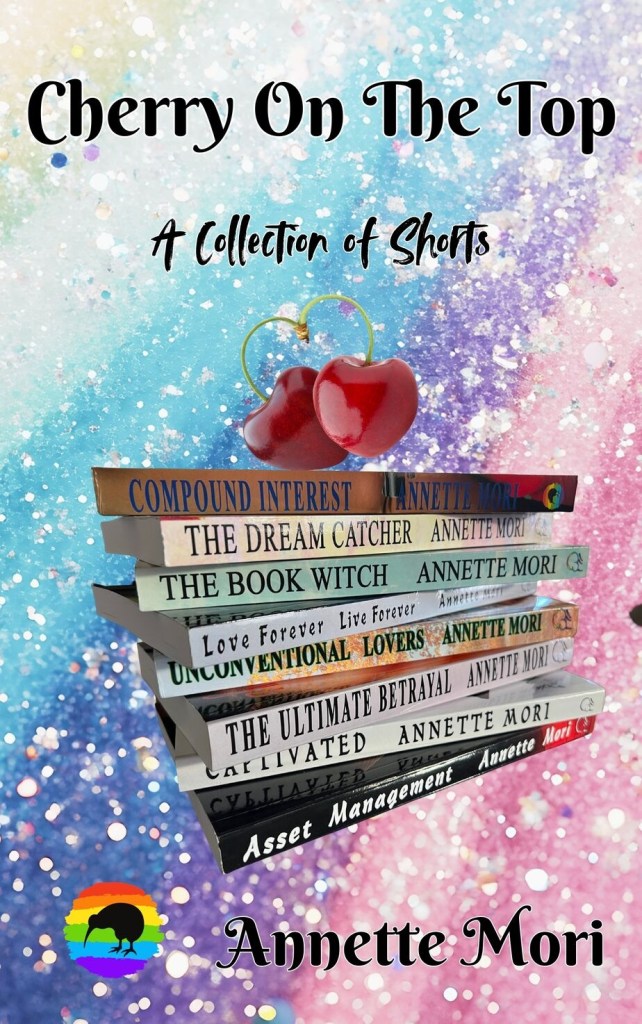
Cherry On The Top – Available in Kindle Unlimited!
Click the cover below for purchase options
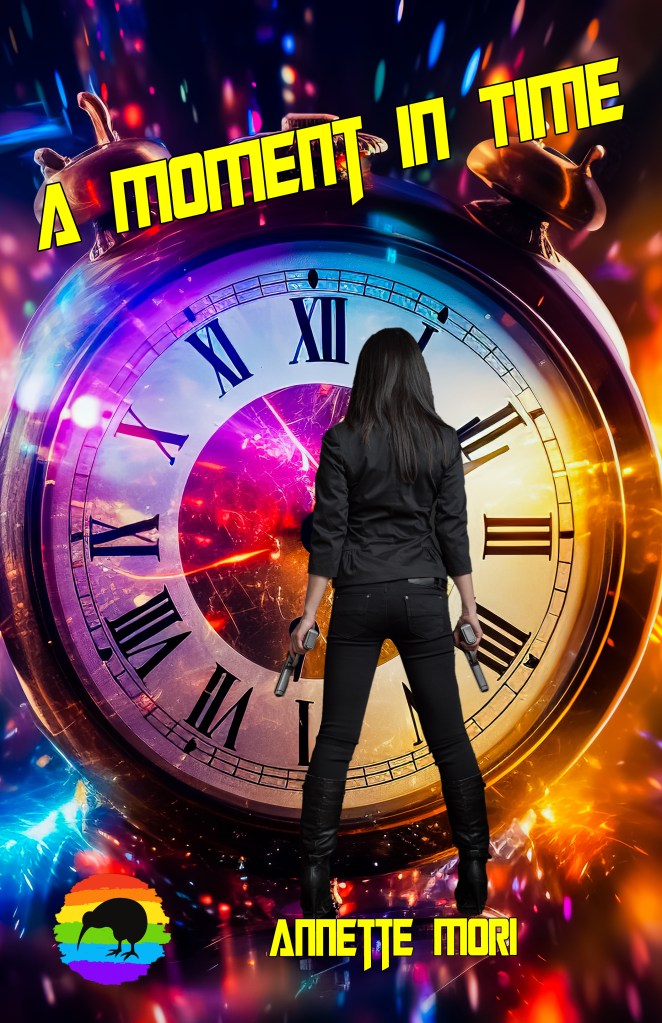
A Moment in Time – Audible Now Available!
Protect the timeline. Guard the woman. Don’t fall in love!
Click the cover below for purchase options
Listen to a clip:
The Invisible Woman: A Lesbian Superhero Story
Click the covers below for purchase options


Listen to a clip:
The Kitten Trap
Click the covers for purchase options

Listen to Audio Clip Below
The Love Demand
Click the covers for purchase links!


Pleasure Workers in Audio

Love Sins – The Final Chapter in The Organization Universe
Click on Cover for purchase links and description


The Final Chapter in the original Organization series is now in Audible

Catch up with Books 1 and 2 in The Next Generation Series



Where it all began….
Click on Covers for purchase links and descriptions


Click on Covers for purchase links and descriptions


Books in Audible
Books In Kindle Unlimited (KU)

Subscribe To Annette’s Substack
Proud to be an Affinity Rainbow Publications Author

